How to Install SQLOPS on a Mac

UPDATE: SQL Operations Studio (SQLOPS) has since been renamed to Azure Data Studio. The steps in this article remain the same though. In any case, I’ve also rewritten these steps (and included the equivalent screenshots) specifically for Azure Data Studio . See How to Install Azure Data Studio on a Mac.

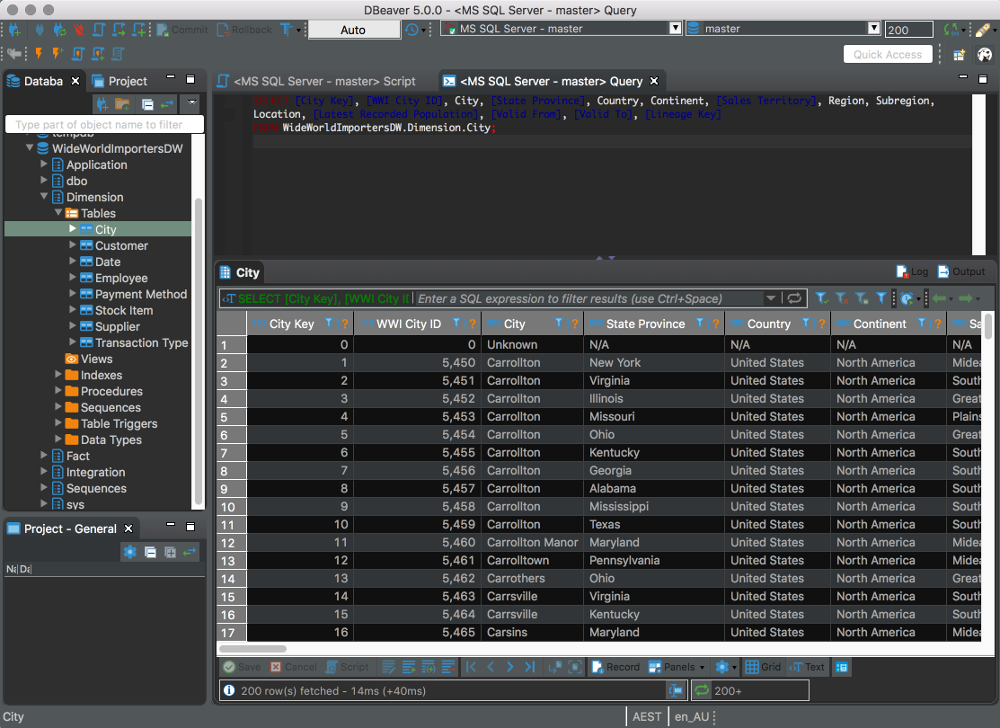
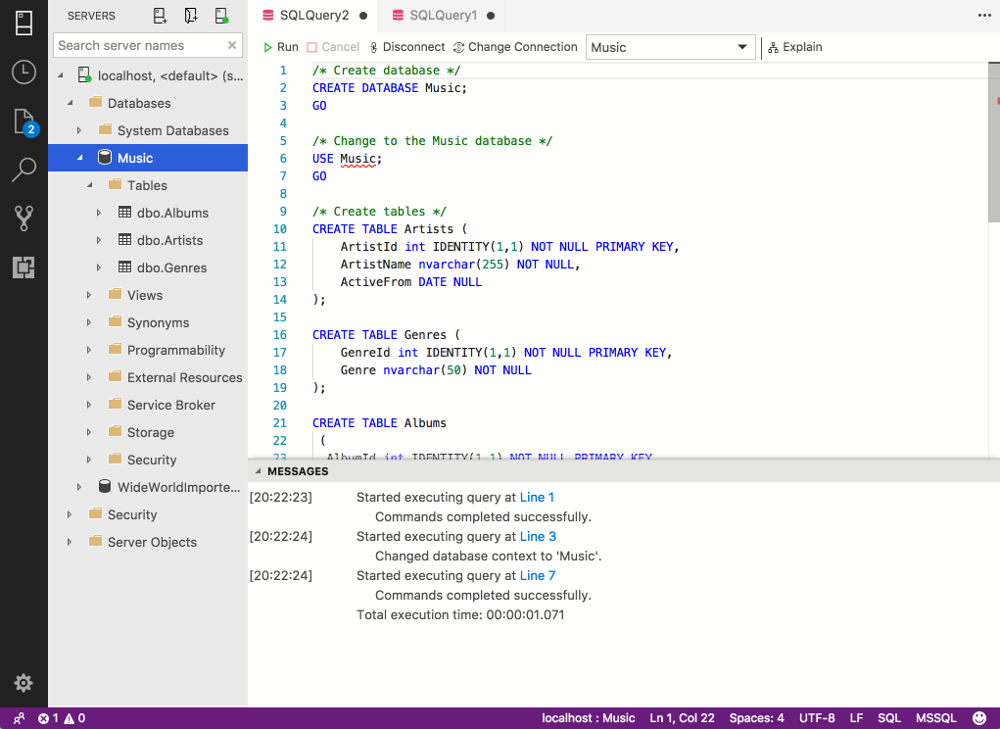
SQL Operations Studio (also abbreviated to SQLOPS) is a free tool that you can use to manage SQL Server. It uses a graphical user interface (GUI) that helps you view the various databases and objects within a SQL Server instance. It can run on Windows, macOS, and Linux, and it’s also designed to be used with Azure SQL Database, and Azure SQL Data Warehouse.

Here I explain how to install SQLOPS onto a Mac, then how to use it to connect to SQL Server.

Read more

What is OLAP?

OLAP (Online Analytical Processing) is a category of database processing that facilitates business intelligence.

OLAP provides analysts, managers, and executives with the information they need to make effective decisions about an organization’s strategic directions. OLAP can provide valuable insights into how their business is performing, as well as how they can make improvements.

Read more

What is Normalization?

Normalization is the process of organizing a database to reduce redundancy and improve data integrity.

Normalization also simplifies the database design so that it achieves the optimal structure composed of atomic elements (i.e. elements that cannot be broken down into smaller parts).

Also referred to as database normalization or data normalization, normalization is an important part of relational database design, as it helps with the speed, accuracy, and efficiency of the database.

Read more

What is the Third Manifesto?

The Third Manifesto is a detailed proposal for the future direction of data and database management systems (DBMSs).

Written by C.J. Date and Hugh Darwen, The Third Manifesto can be viewed as a blueprint for the design of future DBMSs, as well as any language designed to interface with them.

Read more

Codd’s 12 Rules

Codd’s 12 rules is a set of rules that a database management system (DBMS) must satisfy if it’s to be considered relational (i.e. a relational DBMS).

The rules were proposed by Edgar F. Codd, who is considered a pioneer of the relational database model.

Codd’s 12 rules is actually a set of thirteen rules, numbered from zero to twelve. The twelve rules are based on a single foundation rule — Rule Zero.

Read more

RDBMS vs DBMS – What’s the Difference?

There’s a lot of confusion regarding the difference between an RDBMSs and a DBMS. I’ve even seen “RDBMS vs DBMS” forum posts where the accepted answer outlines the differences between RDBMSs and DBMSs, as though they were two distinct and different things.

However, this can be misleading.

The fact is, an RDBMS is a DBMS. But a DBMS is not always an RDBMS (but it often is).

So, is there a difference between an RDBMS and a DBMS or not? Is “RDBMS vs DBMS” the right way of looking at it, or is there more to it?

Read more

How to Install SQL Server on a Mac

Here I’ll show you how to get SQL Server up and running on your Mac in less than half an hour. And the best part is, you’ll have SQL Server running locally without needing any virtualization software.

Back in the old days (prior to SQL Server 2017), if you wanted to run SQL Server on your Mac, you first had to create a virtual machine (using VirtualBox, Parallels Desktop, VMware Fusion, or Bootcamp), then install Windows onto that VM, then finally SQL Server. This is still a valid option depending on your requirements (here’s how to install SQL Server on a Mac with VirtualBox if you’d like to try that method).

But these days you can now install SQL Server directly on to a Linux machine. And because macOS is Unix based (and Linux is Unix based), you can run SQL Server for Linux on your Mac. The way to do this is to run SQL Server on Docker.

Read more