In SQL Server (and Azure), the T-SQL LEN() function returns the number of characters of a specified string expression, excluding trailing blanks.
You provide the string as an argument.
In SQL Server (and Azure), the T-SQL LEN() function returns the number of characters of a specified string expression, excluding trailing blanks.
You provide the string as an argument.
In SQL Server (and Azure), the T-SQL DATALENGTH() function returns the number of bytes used to represent any expression.
For example:
SELECT DATALENGTH('Lit');
Result:
3
In this case, there are 3 bytes in the string Lit.
However, this is a simple example. The results can look a lot different, depending on the data type.
In database systems, Collation specifies how data is sorted and compared in a database. Collation provides the sorting rules, case, and accent sensitivity properties for the data in the database.
For example, when you run a query using the ORDER BY clause, collation determines whether or not uppercase letters and lowercase letters are treated the same.
Collation is also used to determine how accents are treated, as well as character width and Japanese kana characters. Collation can also be used to distinguish between various ideographic variation selectors in certain collations (such as the Japanese_Bushu_Kakusu_140 and Japanese_XJIS_140 collations that were introduced in SQL Server 2017).
Different database management systems will provide different collation options. Depending on the DBMS, collation can be specified at the server level, the database level, the table level, and the column level. Collations can also be specified at the expression level (so you can specify which collation to use when you run a query), and at the identifier level.
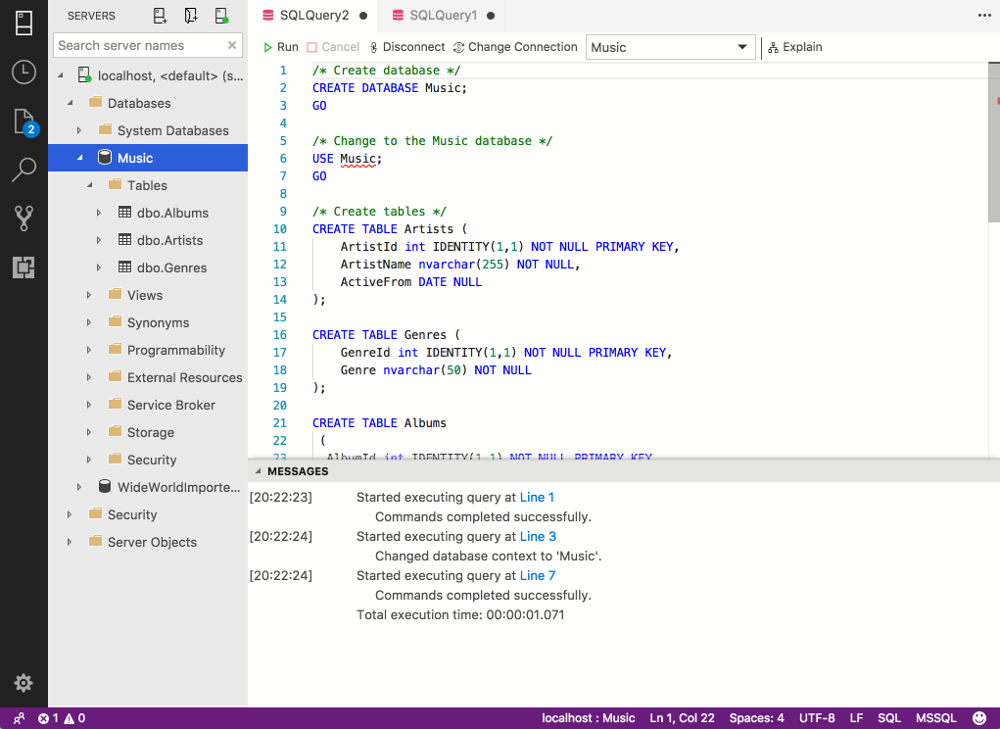
UPDATE: SQL Operations Studio has since been renamed to Azure Data Studio.
SQL Operations Studio (sometimes abbreviated to SQLOPS, SQL Ops Studio, or SQL Ops) is a free, cross-platform tool that can be used to manage SQL Server, Azure SQL Database, and Azure SQL Data Warehouse.
OLAP (Online Analytical Processing) is a category of database processing that facilitates business intelligence.
OLAP provides analysts, managers, and executives with the information they need to make effective decisions about an organization’s strategic directions. OLAP can provide valuable insights into how their business is performing, as well as how they can make improvements.
OLTP (Online Transactional Processing) is a category of data processing that is focused on transaction-oriented tasks. OLTP typically involves inserting, updating, and/or deleting small amounts of data in a database.
OLTP mainly deals with large numbers of transactions by a large number of users.
Normalization is the process of organizing a database to reduce redundancy and improve data integrity.
Normalization also simplifies the database design so that it achieves the optimal structure composed of atomic elements (i.e. elements that cannot be broken down into smaller parts).
Also referred to as database normalization or data normalization, normalization is an important part of relational database design, as it helps with the speed, accuracy, and efficiency of the database.
The Third Manifesto is a detailed proposal for the future direction of data and database management systems (DBMSs).
Written by C.J. Date and Hugh Darwen, The Third Manifesto can be viewed as a blueprint for the design of future DBMSs, as well as any language designed to interface with them.
A column store database is a type of database that stores data using a column oriented model.
A column store database can also be referred to as a: